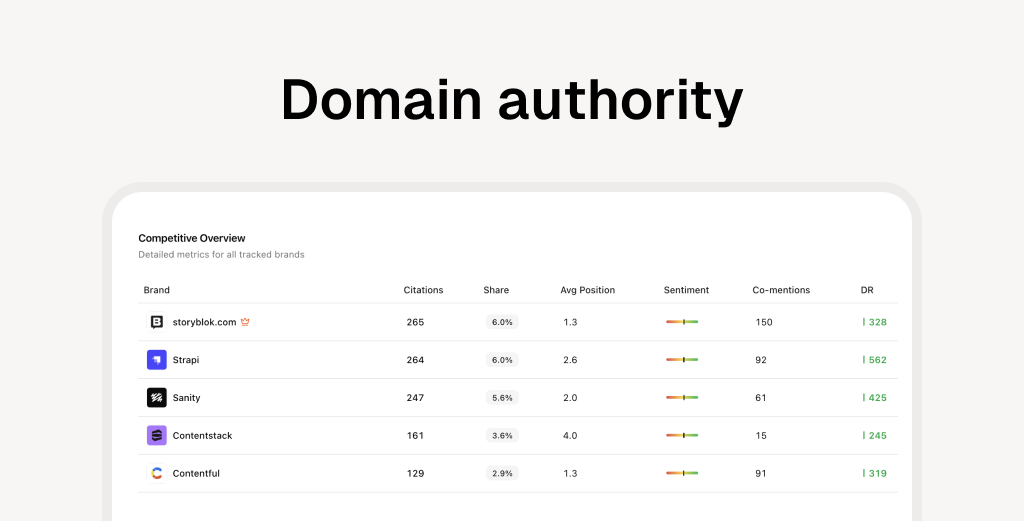
What you’ll learn: This guide explains how domain-level signals like authority, backlinks, and trust rank influence your visibility in AI search. You’ll learn what to measure, what to improve, and how to track domain signals alongside your GEO performance.
Domain signals are measurable indicators of a website’s authority, trust, and credibility, including domain rank, backlinks, referring domains, and trust rank. AI models use these signals indirectly through search retrieval to decide which sources to cite.
Key takeaways:
- Domain signals are the gatekeeper for AI search. Without sufficient authority, your content never reaches the evaluation stage
- Domains with rank 50+ tend to be retrieved more consistently, but topical relevance can override raw authority
- The number of unique referring domains matters more than total backlink count
- Strong domain signals get you retrieved. Strong content gets you cited. You need both
- Building quality backlinks and topical content clusters are the most effective ways to improve domain signals
Why Domain Signals Matter for AI Search
When AI models generate answers, they don’t just look at content quality. They evaluate the source’s credibility before deciding whether to cite it. Domain-level signals are a major part of that evaluation.
Here’s how it works: AI platforms like ChatGPT, Gemini, Perplexity, Claude, and Google AI Overviews use web search as a retrieval step. They query search engines, collect results, and then decide which sources to read and cite. The pages that appear in those search results are heavily influenced by traditional domain signals like authority, backlinks, and trust.
In short: strong domain signals get you retrieved. Strong content gets you cited. You need both.
Key Domain Signals Explained
Domain Rank (DR)
Domain rank is a score (typically 0-100) that estimates the overall authority of a domain based on its backlink profile. Higher DR means search engines (and by extension, AI models) trust your domain more.
| DR Range | What It Means | Typical AI Retrieval |
|---|---|---|
| 0-20 | New or low-authority domain | Rarely retrieved for competitive queries |
| 20-40 | Growing domain with some backlinks | Retrieved for niche or long-tail queries |
| 40-60 | Established domain | Regularly retrieved for relevant topics |
| 60-80 | High-authority domain | Frequently retrieved and cited |
| 80-100 | Top-tier authority | Consistently retrieved and highly cited |
Important: Domain rank is a starting point, not the whole story. A DR 35 site with deeply authoritative content on a niche topic will often outperform a DR 70 site with surface-level coverage.
Trust Rank
Trust rank measures how close your domain is to trusted seed sites in the link graph. Sites linked from universities, government domains, and established publications tend to have higher trust rank.
AI models implicitly use this signal because trusted domains rank higher in search results, which means they get retrieved more often. This connects directly to how E-E-A-T signals affect your citation rate.
Backlinks
Backlinks are links from other websites pointing to your domain. They serve as “votes of confidence” from other sources. For AI search, backlinks matter because:
- They improve your search rankings, increasing the chance of being retrieved by AI
- High-authority backlinks signal expertise on a topic
- Diverse backlinks from relevant domains indicate broad recognition
Referring Domains
The number of unique domains linking to you matters more than total backlink count. 100 links from 100 different domains is stronger than 1,000 links from 5 domains. Diverse referring domains tell AI retrieval systems that multiple independent sources consider your content valuable.
Anchor Text
The text used in backlinks to your site provides topical context. When authoritative sites link to you with relevant anchor text (e.g., “best headless CMS comparison” rather than “click here”), it reinforces your authority on that topic and improves your chances of being retrieved for related AI queries.
How Domain Signals Affect the AI Citation Pipeline
Domain signals play different roles at each stage:
| Stage | Role of Domain Signals |
|---|---|
| Query fan-out | AI generates search queries. Your domain signals don’t matter yet |
| Retrieval | Search results are collected. Domain rank and backlinks determine if your pages appear |
| Evaluation | AI reads retrieved pages. Trust rank influences how much weight your content gets |
| Citation decision | AI decides what to cite. Authority + content quality together determine citation |
The takeaway: domain signals are the gatekeeper. Without sufficient authority, your content never reaches the evaluation stage, regardless of how good it is. For a complete framework on understanding the retrieval-to-citation pipeline, read our beginner’s guide to source gap analysis.
How to Improve Your Domain Signals
Build Quality Backlinks
Focus on earning links from relevant, authoritative sites:
- Publish original research with data others want to reference
- Create comprehensive guides that become go-to resources in your space
- Contribute guest content to industry publications
- Build free tools or calculators that attract natural links
- Participate in industry roundups and expert panels
Strengthen Topical Authority
AI models prefer sources that demonstrate deep expertise on a topic:
- Build content clusters around your core topics (learn how with topic research for GEO)
- Ensure internal linking connects related content
- Cover topics from multiple angles (guides, comparisons, FAQs, case studies)
- Keep content updated with current dates and fresh data
Monitor and Protect Your Profile
- Regularly audit your backlink profile for toxic or spammy links
- Track your domain rank over time to measure progress
- Monitor competitor domain signals to understand the competitive landscape
- Disavow harmful links that could damage trust signals
Tracking Domain Signals in ClayHog
ClayHog’s Domain Signals feature lets you monitor your domain health alongside your GEO performance:
- Domain rank tracking to see your authority score and how it trends over time
- Backlinks analysis showing your link profile strength
- Referring domains count to measure link diversity
- Anchor text analysis to understand how others reference your content
- Competitor domain comparison to see where you stand vs competitors being cited by AI
By tracking domain signals alongside citation data, you can see the direct relationship between authority improvements and AI visibility gains. When your domain rank climbs, you can measure whether retrieval and citation rates follow.
Frequently Asked Questions
Does domain authority affect AI citations?
Yes. AI models use web search results as a primary input, and domain authority influences which pages rank in those results. Higher authority domains are more likely to be retrieved and cited by AI platforms like ChatGPT, Gemini, Perplexity, Claude, and Google AI Overviews.
What is a good domain rank for AI citations?
There is no universal threshold, but domains with a rank of 50+ tend to be retrieved more consistently. However, topical relevance and content quality often matter more than raw domain rank for earning citations.
How do backlinks affect AI search visibility?
Backlinks from authoritative sites signal trust to both search engines and AI models. When your content is referenced by other trusted sources, AI models are more likely to surface and cite your pages in their responses.
Can a low-authority domain still get AI citations?
Yes. If your content is the most relevant and comprehensive source on a niche topic, AI models may cite it even with a lower domain rank. Strong content on a specific topic can overcome lower general authority, especially for long-tail queries.
How long does it take for domain signal improvements to affect AI citations?
Domain authority grows gradually as you earn backlinks and build trust. Most improvements take 3-6 months to meaningfully impact search rankings, which then affects AI retrieval rates. Track both metrics together to see the correlation over time.