GPTBot, ClaudeBot, PerplexityBot, and 25+ other AI crawlers are indexing the web right now. ClayHog shows you exactly which ones visit your site, which pages they crawl, and how often they come back. Pair with prompt tracking and brand visibility monitoring for complete GEO coverage.
Free 7-day trial. No credit card required.
Total visits, top pages, top crawlers, and daily stacked bar charts showing exactly which AI bots crawl your site and how patterns change over time
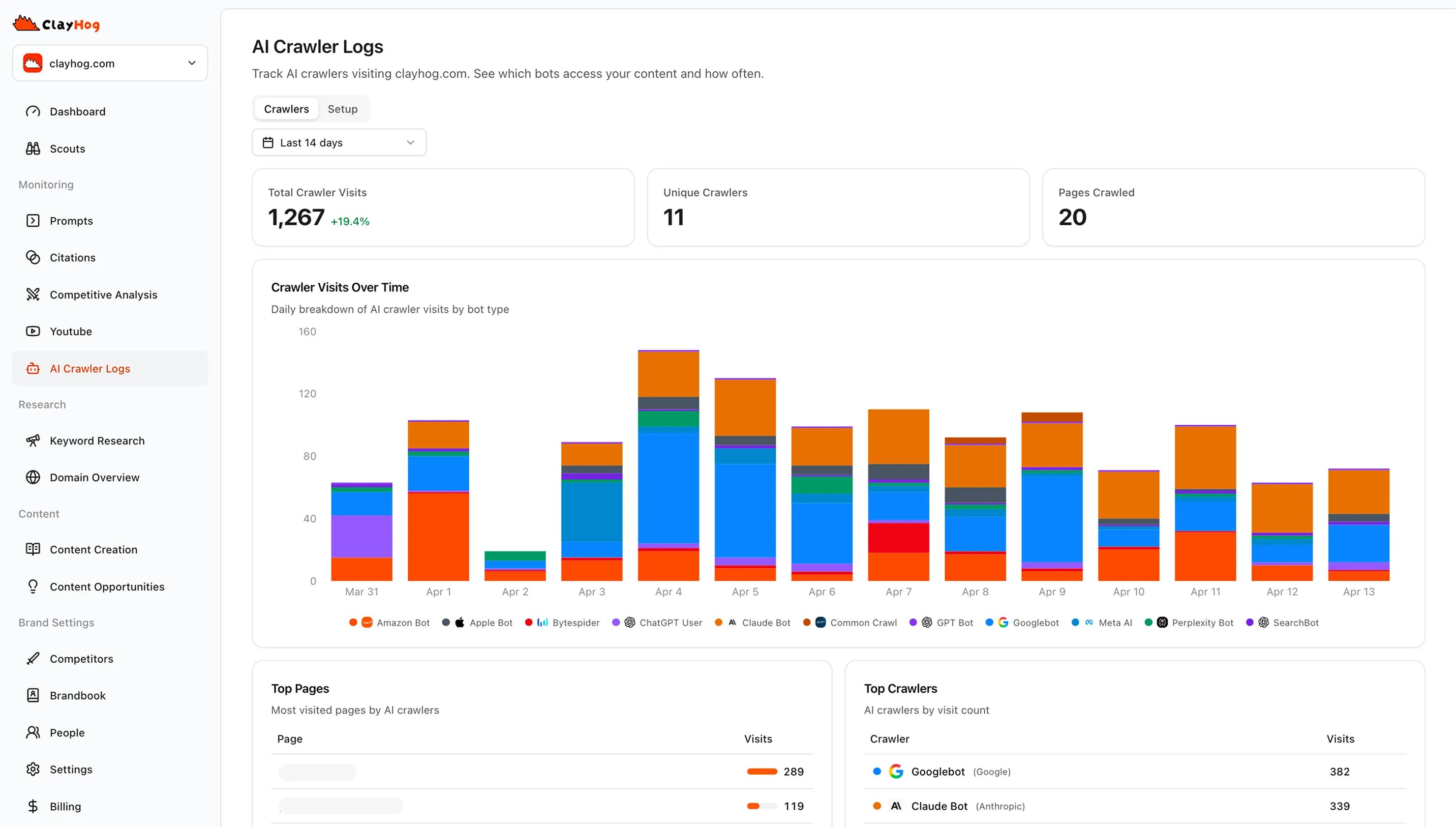
See AI crawler visits as they happen with live log processing from your hosting provider
Know exactly which pages AI bots crawl most and which ones they skip entirely
Track crawlers from OpenAI, Anthropic, Google, Perplexity, Meta, Apple, and more in one dashboard
You can write the best content in your industry, but if GPTBot never visits the page, ChatGPT will never know about it. Crawler logs are the first step in understanding your AI visibility pipeline.
Your homepage might get crawled daily while product pages go untouched for weeks. Page-level data shows you exactly where AI bots spend their time and what they ignore
A sudden drop in GPTBot visits could mean a robots.txt misconfiguration or a crawl budget issue. Daily charts catch these problems before they hurt your AI visibility
Blocking AI crawlers means blocking AI recommendations. Crawler logs confirm whether your robots.txt settings actually allow or deny the bots you intend
Every major AI company's bots, identified and tracked automatically
Connect your hosting provider's log drain to ClayHog and start tracking AI crawler visits immediately
ClayHog matches user agent strings against known AI bot patterns and groups them by company
Understand which AI bots crawl your site and use that data to improve your AI visibility
Verify that AI crawlers can access your key pages. Use crawl data to diagnose robots.txt issues, identify crawl budget problems, and ensure your GEO content is actually being indexed.
Learn more →Understand which AI platforms are actively crawling your content. Use crawler data to prioritize content updates for the platforms that visit most frequently.
Learn more →Show clients concrete proof that AI bots are crawling their sites. Include crawler analytics in GEO reports to demonstrate the foundation of AI visibility.
Learn more →All the AI crawler monitoring capabilities you get with ClayHog.
Monitor how AI platforms respond to specific queries about your brand. Track visibility, citations, and sentiment for every prompt.
Measure how often your brand appears in AI-generated responses. Track visibility trends and benchmark against competitors.
Monitor your brand's presence in Google AI Overviews. Track citations, visibility, and competitor positioning in AI search results.
See which competitors AI crawlers also visit. Compare crawl frequency and coverage with your competitive set.
Create GEO-optimized content that AI crawlers want to index. Built-in quality scoring and E-E-A-T analysis.
Track when AI platforms cite your content as a source. Understand which pages drive the most citations.
Everything you need to know about AI crawler tracking
AI crawler logs track when AI bots visit your website. Every major AI company sends crawlers to index web content for their models. GPTBot collects data for ChatGPT, ClaudeBot for Claude, PerplexityBot for Perplexity, and Google-Extended for Gemini. ClayHog captures these visits from your server logs and shows you exactly which AI bots are crawling your site, which pages they visit, and how often they return.
ClayHog detects 25+ AI crawlers including GPTBot, ChatGPT-User, and OAI-SearchBot (OpenAI), ClaudeBot and Claude-Web (Anthropic), PerplexityBot and Perplexity-User (Perplexity), Google-Extended and Googlebot (Google), Bytespider (ByteDance), meta-externalagent and FacebookBot (Meta), Applebot-Extended (Apple), YouBot (You.com), cohere-ai (Cohere), Amazonbot (Amazon), CCBot (Common Crawl), DuckAssistBot (DuckDuckGo), and more. New crawlers are added as they appear.
Setup takes under five minutes. ClayHog provides a log drain endpoint that connects to your hosting provider. For Vercel, Netlify, and Cloudflare, you paste the endpoint URL into your log drain settings and ClayHog starts processing visits immediately. Each brand gets its own API key and ingest endpoint. No code changes or server modifications are needed.
For each AI crawler visit, ClayHog records the crawler name and company, the page path visited, the HTTP method, status code, IP address, user agent string, and exact timestamp. The analytics dashboard shows total visits with period-over-period comparisons, top pages by crawl volume, top crawlers by visit count, and a daily stacked bar chart showing crawl trends over time.
If AI crawlers are not visiting your pages, those pages cannot appear in AI-generated responses. Crawler logs tell you whether AI bots are actually indexing your content. If GPTBot has never visited your product pages, ChatGPT has no way to recommend them. By tracking crawl patterns, you can identify pages that AI bots ignore, fix crawl barriers, and verify that your most important content is being indexed by the AI platforms you care about.
ClayHog supports log drains from Vercel, Netlify, and Cloudflare out of the box. A manual integration option is also available for any provider that can forward HTTP access logs via webhook. Each integration type has its own parser, so log formats are handled automatically. Setup is a one-time configuration that takes under five minutes.
Have more questions? Learn more about GEO optimization or explore our learning center.
Connect your log drain in under five minutes. See your first AI crawler data the same day. Free 7-day trial, no credit card required.