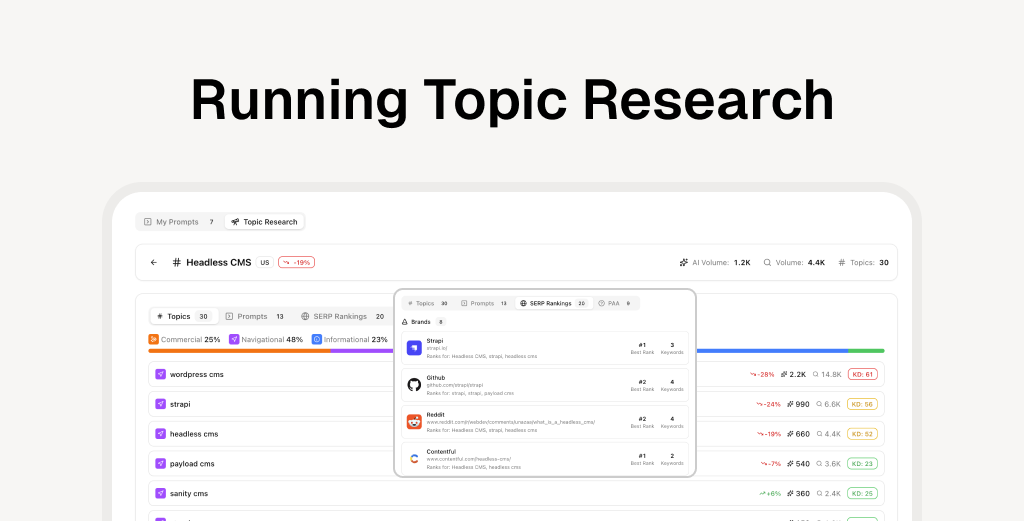
What you’ll learn: How to use topic research to find high-value GEO opportunities, understand AI volume vs search volume, and turn research into trackable prompts that improve your AI search visibility.
Topic research in GEO is the process of discovering which topics and queries generate AI responses relevant to your brand, helping you identify prompts worth tracking and content gaps to fill.
Key takeaways:
- A topic can have low search volume but high AI volume, making it a hidden GEO opportunity
- People Also Ask questions are gold for GEO because AI models use them as query fan-outs
- Topics with high AI volume and moderate competition are the sweet spot for content creation
- Intent classification (branded, informational, commercial, transactional) determines what content type to create
- Topic research should be done at least monthly as AI search trends shift with model updates
Why Topic Research Matters for GEO
Traditional SEO starts with keyword research. GEO starts with topic research.
The difference is important. In traditional search, you target specific keywords to rank for. In AI search, you need to understand which topics trigger AI responses, what intent those queries carry, and which sources AI models prefer to cite when answering.
Topic research helps you answer three critical questions:
- What should I track? Which prompts are worth monitoring across AI platforms?
- What should I create? Where are content gaps that could earn you citations?
- What should I optimize? Which existing content could perform better with improvements?
Understanding the Key Metrics
AI Volume vs Search Volume
These two metrics tell different stories:
| Metric | What It Measures | Why It Matters for GEO |
|---|---|---|
| Search Volume | Monthly searches on Google/Bing | Shows traditional demand |
| AI Volume | How often a topic triggers AI responses | Shows AI search opportunity |
| CPC | Cost per click in paid search | Indicates commercial value |
| Competition | How many sites compete for this topic | Shows difficulty level |
A topic can have low search volume but high AI volume. For example, “best headless CMS for enterprise with API-first architecture” might get few Google searches but frequently triggers detailed AI responses. These are your GEO opportunities. Understanding how source gaps work helps you evaluate which opportunities are worth pursuing.
Pro tip: Look for topics with high AI volume and moderate competition. These are the sweet spot where creating quality content has the highest chance of earning citations.
Intent Breakdown
Every topic carries intent. Understanding intent helps you create content that matches what AI models look for:
| Intent | What the User Wants | Content Type to Create |
|---|---|---|
| Branded | Information about a specific brand | Brand pages, feature docs |
| Informational | Learn about a concept | Guides, explainers, glossaries |
| Navigational | Find a specific page or tool | Landing pages, documentation |
| Commercial | Compare options before deciding | Comparison pages, listicles, reviews |
| Transactional | Ready to take action | Pricing pages, signup flows, demos |
ClayHog’s topic research shows you the intent breakdown for each topic so you can match your content strategy accordingly.
Step-by-Step: Running Topic Research
Step 1: Start with Your Core Topics
Enter the broad topics relevant to your business. For example, if you’re in the headless CMS space:
- “headless CMS”
- “content management API”
- “structured content”
- “composable architecture”
Step 2: Review AI Volume and Trends
For each topic, look at:
- AI volume: How often does this trigger AI responses?
- Trend direction: Is AI interest growing or declining?
- Monthly search volume: What’s the traditional search demand?
- SERP features: Are there featured snippets, People Also Ask boxes, or AI overviews?
Step 3: Explore People Also Ask Questions
People Also Ask (PAA) questions are gold for GEO. These are the exact questions users ask, and AI models frequently use them as query fan-outs when generating responses.
For “headless CMS,” PAA questions might include:
- “What is the difference between headless and traditional CMS?”
- “Is headless CMS good for small business?”
- “Which headless CMS has the best API?”
- “How much does a headless CMS cost?”
Each of these is a potential prompt to track and a content piece to create.
Step 4: Analyze SERP Features
Topics that already trigger rich SERP features (featured snippets, knowledge panels, AI overviews) are more likely to generate AI citations. These are topics where search engines already recognize the need for structured, authoritative answers.
Step 5: Generate Prompts from Research
The most valuable output of topic research is a set of tracked prompts. In ClayHog, you can convert topic research results directly into prompts:
- Select topics with high AI volume
- Review related queries and PAA questions
- Generate prompts with proper intent tagging (branded, informational, commercial, etc.)
- Set up regional tracking if relevant
- Activate tracking across ChatGPT, Gemini, Perplexity, Claude, and Google AI Overviews
Turning Research into Content Strategy
Map Topics to Content Types
Based on your research, create a content plan:
| Topic Cluster | Primary Intent | Content to Create |
|---|---|---|
| ”What is [topic]” queries | Informational | Definitive guide with clear definitions |
| ”Best [product] for [use case]“ | Commercial | Comparison listicle with structured data |
| ”[Product A] vs [Product B]“ | Transactional | Side-by-side comparison page |
| ”How to [action]” queries | Informational | Step-by-step tutorial |
| PAA questions | Mixed | FAQ section or dedicated answer pages |
Prioritize by Opportunity
Not every topic is worth pursuing. Prioritize based on:
- AI volume: Higher volume means more potential citations
- Competition: Fewer cited competitors means easier entry
- Business relevance: Does this topic align with your product?
- Content gap: Do you already have content on this, or do you need to create from scratch?
Track and Iterate
Topic research isn’t a one-time exercise. AI search evolves as models update and new content gets published. If you’re tracking across multiple regions, check our guide on how regional targeting impacts AI search visibility. Set a regular cadence:
- Weekly: Check prompt performance for newly tracked topics
- Monthly: Run fresh topic research to discover new opportunities
- Quarterly: Review your overall topic strategy and adjust priorities
Using Topic Research in ClayHog
ClayHog’s topic research is built directly into the prompts workflow:
- Discover topics with AI volume, search volume, CPC, and competition data
- See intent breakdowns for each topic to guide content creation
- Explore People Also Ask questions that map to real user queries
- Review SERP features to identify high-opportunity topics
- Generate prompts from keywords to start tracking immediately
- AI-powered prompt suggestions based on your brand information
Instead of jumping between keyword tools and your GEO platform, everything lives in one place. Research a topic, generate prompts, track performance, and create content, all within the same workflow.
Frequently Asked Questions
What is topic research in GEO?
Topic research in GEO is the process of discovering which topics and queries generate AI responses relevant to your brand. It helps you identify prompts worth tracking, content gaps to fill, and keywords that drive AI visibility.
What is AI volume?
AI volume measures how frequently a topic or keyword triggers AI-generated responses across platforms like ChatGPT, Gemini, Perplexity, Claude, and Google AI Overviews. High AI volume topics are more likely to generate AI answers where your brand could be cited.
How is topic research different from keyword research?
Keyword research focuses on search terms people type into Google. Topic research for GEO focuses on the broader topics that trigger AI responses. A single topic might encompass dozens of related prompts, and the goal is citations in AI answers rather than rankings in search results.
How do I turn topic research into trackable prompts?
In ClayHog, you can generate prompts directly from topic research results. Select a topic, review its related queries and People Also Ask questions, and convert them into tracked prompts with one click. Tag them by intent for better analysis later.
How often should I do topic research?
At minimum monthly. AI search trends shift as models update and new content enters the ecosystem. Regular research helps you catch emerging topics early and stay ahead of competitors.