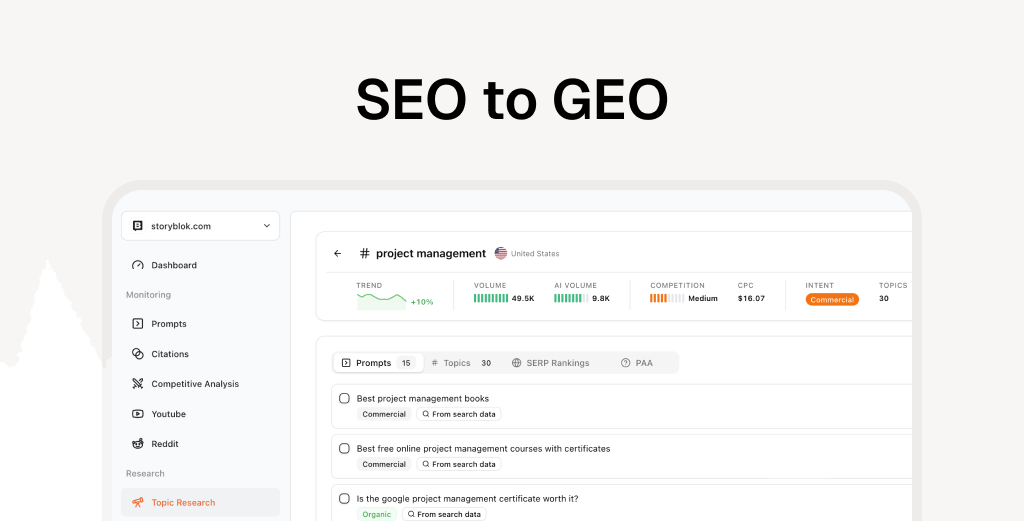
If you work in SEO, you’ve probably noticed it: organic traffic is declining even when rankings hold steady. Users are getting answers directly from AI instead of clicking through to search results.
This isn’t a temporary blip. Gartner predicts a 50% drop in traditional organic search traffic by 2028. The traffic isn’t disappearing. It’s moving to AI platforms.
This guide is for SEO professionals who want to understand GEO, see how it maps to their existing skills, and start capturing AI search visibility alongside their traditional SEO work.
What you’ll learn: How GEO relates to SEO, which skills transfer directly, how to set up your first GEO workflow, and what to prioritize when you’re starting from zero.
Why SEO Teams Need to Pay Attention
The numbers tell the story:
- ChatGPT has over 830 million weekly active users
- Gemini has 640 million monthly active users
- Perplexity processes over 20 million queries per month
When someone asks ChatGPT “What’s the best project management tool for remote teams?” they get a direct answer with brand recommendations. No list of 10 blue links. No chance to rank your way onto page one with a well-optimized title tag.
Your brand either gets mentioned in that answer, or it doesn’t. That’s what GEO tracks and optimizes.
How GEO Maps to Your SEO Workflow
The good news is that GEO isn’t a completely new discipline. Many of the concepts you already use translate directly.
Keywords become Prompts
In SEO, you track keyword rankings. In GEO, you track prompt visibility.
A prompt is the question or instruction a user gives to an AI platform. Instead of tracking whether you rank #3 for “best CRM for startups,” you track whether ChatGPT mentions your brand when someone asks “What’s the best CRM for startups?”
The research process is similar. You identify the questions your target customers ask AI platforms, categorize them by intent (brand, organic, competitor), and monitor how AI responds over time.
Backlinks become Citations
In SEO, backlinks signal authority. In GEO, citations serve a similar role.
When an AI model cites your website as a source in its response, that’s a citation. It means the AI considers your content authoritative enough to reference. Tracking which of your pages get cited (and which don’t) tells you where your content authority is strong and where it’s weak.
This maps directly to source gap analysis in GEO.
On-page optimization becomes AI-friendly content
In SEO, you structure content for search engine crawlers and users. In GEO, you structure content so AI models can extract and reference it effectively.
This includes:
- Clear, direct answers to specific questions (AI models pull from concise, well-structured content)
- Entity-rich writing that names specific products, categories, and concepts
- Structured data that helps AI understand your content’s context
- E-E-A-T signals that build the trust AI models look for when selecting sources
For more on how these signals work, see how E-E-A-T signals affect AI citation rates.
Competitor analysis becomes AI visibility benchmarking
In SEO, you check which competitors rank for your target keywords. In GEO, you check which competitors get mentioned in AI responses to your target prompts.
The analysis is similar: you identify where competitors outperform you, understand why, and create content to close the gap. The difference is the channel. Instead of looking at search engine results pages, you’re looking at AI-generated answers.
Where GEO Differs from SEO
Not everything maps one-to-one. Here are the key differences:
There’s no “page one”
In traditional search, you optimize to rank on page one. Position 1 gets more clicks than position 5, but position 5 still gets traffic.
In AI search, you’re either mentioned in the response or you’re not. There’s no partial credit. Your brand is either part of the conversation or invisible.
Sentiment matters
Google doesn’t care whether a website speaks positively about your brand. AI models do. If AI consistently describes your product with negative sentiment or qualifications (“some users report issues with…”), that shapes how users perceive you.
GEO tools track sentiment so you can identify and address how AI frames your brand.
Content freshness is weighted differently
Traditional search indexes and ranks pages continuously. AI models have different update cycles. Some pull from training data that’s months old. Others (like Perplexity) use real-time web retrieval.
This means your GEO content strategy needs to account for both long-lived authority content and regularly updated material that keeps AI retrieval sources current.
AI models can synthesize across sources
Google shows individual pages. AI models synthesize information from multiple sources into a single answer. This means your content doesn’t just need to exist. It needs to be the content AI models consider most authoritative and relevant when composing their response.
Getting Started: Your First GEO Workflow
Here’s a practical step-by-step process for SEO teams adding GEO to their workflow.
Step 1: Audit your current AI visibility
Before optimizing, you need a baseline. Start with our free GEO audit to get an instant score across 8 dimensions of AI search readiness. Then set up a GEO tool and add the prompts your target customers are likely asking AI platforms.
Start with:
- Brand prompts: “Is [your brand] good?”, “Tell me about [your brand]”
- Category prompts: “Best [your category] tools”, “Top [your category] for [use case]”
- Competitor prompts: “[Your brand] vs [competitor]”, “[Competitor] alternative”
Most GEO tools will show you results within minutes of setup.
Step 2: Identify your visibility gaps
Once you have baseline data, look for:
- Prompts where competitors are mentioned but you’re not: These are your priority gaps
- Prompts where you’re mentioned with negative sentiment: These need content fixes
- Prompts where you’re cited as a source: These show what’s working
Step 3: Map gaps to content opportunities
For each visibility gap, identify what content would help. This usually falls into one of these categories:
- Missing content: You don’t have a page that addresses the topic at all
- Weak content: You have a page but it lacks depth, authority signals, or structured answers
- Outdated content: Your content exists but hasn’t been updated, and AI models favor fresher sources
Step 4: Create AI-optimized content
Write content that directly answers the prompts you want to be visible for. Structure it with:
- Clear headings that match the question being asked
- Direct, factual answers in the first paragraph
- Supporting evidence (data, examples, expert insights)
- Proper schema markup
- Internal links to related content on your site
If you’re using ClayHog, the built-in content creator generates articles based on your visibility data and prompts, structured for AI citation.
Step 5: Monitor and iterate
GEO isn’t a one-time project. Set a regular cadence to:
- Review visibility scores weekly
- Track citation trends monthly
- Update content when visibility drops
- Add new prompts as you discover what customers are asking
Common Mistakes SEO Teams Make with GEO
Treating GEO as a replacement for SEO. It’s not. GEO is an additional channel. Your SEO fundamentals (site speed, technical health, link building) still matter and actually support your GEO performance.
Only tracking brand prompts. Brand queries are important, but the biggest opportunity is in category and use-case prompts where users discover new brands. “Best CRM for startups” captures more new customers than “Is [your brand] good?”
Ignoring sentiment. Visibility without positive sentiment can hurt more than help. If AI says your product is “popular but has reliability issues,” being visible isn’t a win.
Publishing content and not monitoring. AI model responses change as new content is indexed and training data is updated. Content that earns citations today might lose them in a month if competitors publish better material.
Tools for the Job
Your existing SEO stack doesn’t track AI search. You’ll need a dedicated GEO tool alongside your current tools.
For a comprehensive comparison of available options, see our best GEO tools in 2026 guide.
ClayHog is built specifically for teams coming from an SEO background. The workflow mirrors what you’re already used to: add prompts like keywords, track visibility like rankings, monitor citations like backlinks. It starts at EUR 29/month and includes a free trial.
What to Prioritize This Quarter
If you’re adding GEO to your SEO workflow for the first time, focus on these three things:
- Get visibility data. You can’t optimize what you can’t measure. Set up a GEO tool and benchmark your current state.
- Close your top 5 gaps. Find the 5 most important prompts where competitors are visible and you’re not. Create or improve content for those first.
- Build a reporting cadence. Add AI search visibility to your monthly SEO reporting. Track it alongside your traditional metrics so stakeholders see the full picture.
The SEO teams that start tracking and optimizing for AI search now will have a compounding advantage over those that wait. The same way early SEO adopters built positions that are still hard to displace, early GEO adopters are building AI search presence that will be difficult for latecomers to match.
Start tracking your AI search visibility today. ClayHog gives SEO teams the same workflow they’re used to, applied to AI search. Track brand visibility and AI Overviews in one dashboard. Free 7-day trial, no credit card required. Start your free trial.