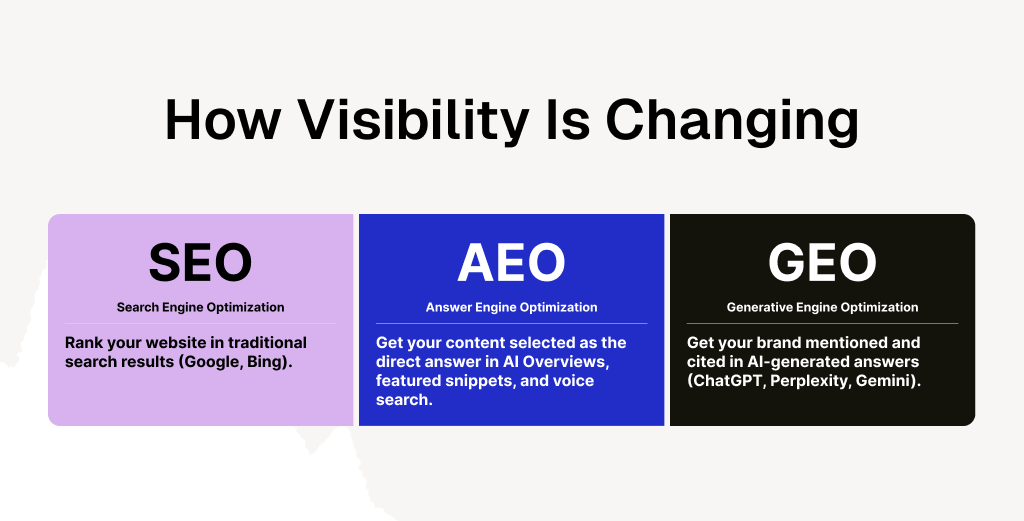
When someone searches for your product or service in 2026, the answer shows up in three different places. A list of websites on Google. A direct answer in Google’s AI Overview. And a recommendation from ChatGPT or Gemini.
Most brands optimize for the first one. A growing number are starting to think about the second. Almost none are paying attention to the third.
That is a problem. Over 800 million people use ChatGPT every week. Hundreds of millions more use Gemini, Perplexity, and Claude. When a potential customer asks “What’s the best [your category] for [their use case]?” they get a curated list of recommendations, not a page of blue links.
Your brand is either on that list, or it’s invisible.
This guide breaks down the three optimization strategies that determine where and how your brand gets discovered: SEO, AEO, and GEO. We cover how each one works, where it falls short, and what you can do to rank higher across all three.
What you’ll learn: The difference between SEO, AEO, and GEO. How each one works in practice. Their strengths and weaknesses. And actionable steps to improve your visibility across all three channels.
Three Channels, One Query
Let’s walk through what happens when someone searches for a product or service like yours in 2026.
Channel 1: Google Search Results (SEO)
The prospect types a query into Google and gets a list of organic results. Maybe it’s a review site, maybe it’s a roundup article, maybe it’s your own website if you’ve done the SEO work. The prospect scans the titles, clicks one or two, and browses.
This is the channel most brands know best. It’s been the primary discovery mechanism for two decades.
Channel 2: Google AI Overview (AEO)
The same query now triggers a Google AI Overview at the top of the results page. Google pulls a direct answer from the web: “The best option depends on your needs and budget. Top-rated providers for 2026 include…” followed by a synthesized list.
If your content provides clear, structured answers to common questions, Google extracts it and puts it front and center. If not, a competitor’s content fills that space.
Channel 3: AI Platforms (GEO)
The prospect opens ChatGPT and asks “What’s the best [your category] for [their specific need]?” ChatGPT responds with a detailed answer naming specific brands, explaining what each one is known for, and recommending options based on the prospect’s situation.
No search results page. No list of links. Just a direct recommendation. Your brand either gets named, or it doesn’t.
The brands winning customers in 2026 are visible across all three channels. Each one captures a different moment in the discovery process. Ignoring any of them means losing prospects to competitors who show up where you don’t.
What Is SEO (Search Engine Optimization)?
SEO is the practice of getting your website to appear in traditional search results when people search for relevant terms.
This means ranking for queries like “best [your product category],” “[your service] in [location],” “[your category] for [use case],” and similar high-intent searches.
How SEO Works
Identify high-intent keywords and map them to pages on your site. Research the terms your ideal customers use when looking for what you offer. Map those keywords to specific pages. “Best CRM for startups” should land on a dedicated page, not your homepage.
Build authoritative backlinks and optimize on-page content. Get featured on relevant directories and review platforms. Earn links from publications in your industry. Optimize title tags, meta descriptions, and headers to match search intent.
Maintain technical health. Fast load times, clean site structure, XML sitemaps, mobile responsiveness. The fundamentals haven’t changed.
Pros
- Proven, steady traffic driver. SEO has been the backbone of online discovery for years. A well-ranked page delivers qualified traffic month after month.
- Builds long-term authority. Rankings compound over time. A brand that has held position 1 for a competitive keyword for two years is difficult to displace.
Cons
- Slow to show results. A new page can take 3 to 6 months to reach page one, even with strong content and backlinks.
- Vulnerable to algorithm updates. A single Google core update can shift rankings overnight. Brands that depend entirely on organic search face periodic volatility.
- Increasing competition from AI-generated answers. As Google AI Overviews expand, traditional organic results get pushed further down the page. Click-through rates on standard search results are declining.
How to Rank Higher with SEO
- Focus on high-intent keyword clusters specific to your offering. Don’t chase broad terms when more specific queries convert better and have less competition.
- Run regular technical audits and refresh content quarterly. Outdated content and stale descriptions signal neglect to both Google and prospects.
- Build your presence on aggregator and review sites. G2, Capterra, Clutch, Trustpilot, and industry-specific directories rank for high-intent queries. Getting listed and reviewed there puts you in the search results even if your own site doesn’t rank for that specific term.
- Create content around questions people ask before buying. “How much does [your category] cost?”, “How to choose the right [your product type]”, “[Your category] vs [alternative].” These informational queries build awareness and backlinks.
What Is AEO (Answer Engine Optimization)?
AEO is the practice of getting your expertise extracted into Google answer boxes, featured snippets, and AI Overviews.
When someone searches “What is [your product category]?” or “How much does [your service] cost?” Google often displays a direct answer pulled from a web page. That answer position gets massive visibility: it appears above all organic results.
How AEO Works
Provide concise, direct answers to the questions your customers are asking. Structure your content so that the first paragraph under each heading answers the question clearly. Google extracts content that gets to the point.
Use FAQ and How-To schema for structured data. Adding FAQ schema to your pages and blog posts tells Google that your content contains structured answers. This directly improves your chances of appearing in featured snippets and AI Overviews.
Pros
- Instant authority and brand visibility. Appearing in the answer box positions your brand as the definitive source. People see your answer before they see any other search result.
- Strong for voice and mobile queries. When someone asks Google Assistant a question about your category, the answer box response is what gets read aloud. Mobile searches increasingly trigger AI Overviews, making AEO the default experience.
Cons
- Some users get the answer without clicking through. If Google surfaces your pricing breakdown directly in the search results, the prospect may not visit your site at all. You get visibility but not always the visit.
- Snippet positions change frequently. The page Google extracts for a featured snippet can change weekly. Maintaining an answer box position requires ongoing monitoring and content updates.
How to Rank Higher with AEO
- Answer questions in 40 to 60 words under clear headings. The ideal featured snippet answer is concise, direct, and immediately follows a question-format heading. “How much does [your product] cost?” followed by a 2-sentence answer with specific numbers performs better than a 500-word preamble.
- Add structured schema to FAQ and How-To content. Implement FAQ schema on your key pages and blog posts. Use How-To schema for process-oriented content.
- Target question-based queries with dedicated sections. Identify the top 20 questions people ask before making a purchase decision in your category. Create content that answers each one directly. Common patterns:
| Question type | Content approach |
|---|---|
| How much does [product/service] cost? | Pricing page with clear ranges and factors |
| What does [product/service] do? | Overview page with specific capabilities |
| How do I choose the right [category]? | Guide with evaluation criteria and checklist |
| What questions should I ask before buying? | List post with key decision-making questions |
| [Your category] vs [alternative]? | Comparison page with pros, cons, and use cases |
What Is GEO (Generative Engine Optimization)?
GEO is the practice of getting your brand cited by name in AI-generated recommendations from platforms like ChatGPT, Gemini, Perplexity, Claude, and Google AI Overviews.
When someone asks ChatGPT “What’s the best tool for [your category]?” or tells Perplexity “Find me a [your service] that specializes in [specific need],” the AI responds with specific brand names and recommendations. GEO determines whether your brand is one of them.
How GEO Works
Publish clear, well-structured thought leadership with citations and data. AI models favor content that demonstrates expertise. Case studies with real numbers, industry reports with original data, and guides backed by research all increase your chances of being cited.
Build presence on the credible sources AI models pull from. AI platforms don’t just read your website. They synthesize information from across the web. If your brand is mentioned on review platforms, industry publications, podcasts, Reddit discussions, and YouTube, AI models have more signals to draw from when making recommendations.
Pros
- Early-mover advantage in AI search. Most brands are not doing any GEO work. The ones that start now build AI visibility that compounds over time, the same way early SEO adopters built positions that are still difficult to displace.
- Positions your brand as a trusted authority. When ChatGPT recommends your brand by name and explains what you’re known for, that carries significant weight with prospects. It’s an implicit endorsement from a platform hundreds of millions of people trust.
Cons
- Hard to measure direct impact. Unlike SEO where you can track clicks and conversions from organic search, attributing a new customer to an AI recommendation is harder. Prospects may not tell you “ChatGPT recommended you.”
- Requires multi-platform presence beyond your website. Your website alone isn’t enough. AI models pull from dozens of sources. Building the breadth of presence needed for consistent AI visibility takes sustained effort across content, PR, directories, and community platforms.
How to Rank Higher with GEO
- Create factual, entity-rich content following E-E-A-T principles. AI models trust content from sources with demonstrable expertise, experience, authoritativeness, and trustworthiness. Include real results, cite industry data, and back up your claims with evidence.
- Contribute to sources AI frequently references. Industry reports, relevant publications, podcast interviews, review platforms, and community forums all feed into what AI models know about your brand.
- Monitor what AI says about you and your competitors. You need to know whether AI platforms recommend you, how they describe you, and which competitors they mention instead. Without this data, you’re optimizing blind.
How All Three Work Together
SEO, AEO, and GEO aren’t competing strategies. They’re three layers of the same visibility funnel.
| Stage | Channel | What happens | Example |
|---|---|---|---|
| Awareness | GEO | Prospect asks AI for recommendations | ”ChatGPT, what’s the best [category] for my needs?” |
| Research | AEO | Prospect searches and gets direct answers | Google AI Overview: “Top [category] options include…” |
| Evaluation | SEO | Prospect visits websites from search | Clicks through to your product pages, case studies, and reviews |
A prospect who hears your brand name from ChatGPT, then sees it again in a Google AI Overview, and then finds your website ranking on page one has encountered you three times through three different channels. That level of visibility builds confidence.
The brands that treat these as separate, competing priorities miss the compounding effect. The ones that align all three create a discovery experience that’s hard for competitors to match.
The Reinforcing Loop
Strong SEO supports GEO. About 50% of sources cited by AI models also rank in Google’s top 10, according to BrightEdge. If your content ranks well in search, AI models are more likely to retrieve and cite it.
Strong AEO supports GEO. Content structured for featured snippets (clear headings, direct answers, FAQ schema) is also the format AI models extract most easily.
Strong GEO supports SEO. When AI platforms recommend your brand, some prospects will Google your name to learn more. That branded search activity signals relevance to Google and supports your organic rankings.
All three feed each other. Investing in one strengthens the others.
What Most Brands Get Wrong
Only optimizing for SEO and ignoring AI channels. This is the most common mistake. Traditional organic search is still important, but it’s no longer the only place people discover brands. If your SEO is strong but AI platforms never mention you, you’re invisible to a growing segment of potential customers.
Keeping your best content locked on your own site. Your website isn’t the only place AI models look. If your best case studies, data, and expertise only live on your domain, AI has limited signals to draw from. The same results and insights should appear on review platforms, in guest articles, and on the channels where AI models can find them.
No structured data or FAQ schema on key pages. Without structured markup, Google has to guess what your content is about. FAQ and How-To schema make it explicit. This is a quick win for AEO that most websites are missing.
Not monitoring what AI platforms say about you. Many brands have never asked ChatGPT “What’s the best [their category]?” They don’t know whether AI recommends them, how AI describes them, or which competitors AI mentions instead. You can’t improve what you’re not measuring.
Treating thought leadership as optional. Brands that only publish promotional content give AI nothing to cite when it needs to answer a category question. Genuine expertise content, published consistently, is what earns AI recommendations.
A Step-by-Step Plan to Get Started
Month 1: Foundation and Quick Wins
Week 1 - Audit your current visibility:
- Search “best [your category]” on Google, ChatGPT, Gemini, and Perplexity. Record where you appear and where you don’t.
- Run a free GEO audit to get a baseline score across 8 dimensions of AI search readiness.
- Check your
robots.txtto make sure AI crawlers (GPTBot, ClaudeBot, PerplexityBot) can access your site.
Week 2 - Fix AEO basics:
- Add FAQ schema to your top 5 pages.
- Restructure your most important blog posts with question-based headings and direct answers in the first paragraph.
- Create or improve a pricing page that answers “How much does [your product] cost?” with clear ranges. Pricing queries are among the highest-volume AEO opportunities in most categories.
Weeks 3-4 - Set up GEO tracking:
- Add 15 to 20 prompts covering your brand, your category, your top competitors, and common prospect questions.
- Track across ChatGPT, Gemini, Perplexity, Claude, and Google AI Overviews.
- Identify where competitors are mentioned and you’re not. These are your priority gaps.
Month 2: Content and Authority
Create 2 to 4 articles targeting your highest-priority prompt gaps. If ChatGPT recommends three competitors for “best [your category]” and doesn’t mention you, that’s the content gap to close first.
Publish one piece of original research. Survey your customers about a trend in your industry. Analyze your own product data. Original data gets cited by AI at significantly higher rates than generic content.
Update your review and directory profiles. Make sure your profiles on G2, Capterra, Clutch, Trustpilot, or whatever platforms are relevant to your industry are complete, current, and include recent results. These platforms are among the most frequently cited sources when AI makes recommendations.
Start contributing to relevant communities. Reddit threads, industry forums, and niche communities frequently get pulled into AI training and retrieval data. Share genuine expertise, not promotional content.
Month 3: Scale and Compound
Review your visibility data and double down on what works. Check which prompts now show your brand and which still don’t. Content that earned mentions should be expanded. Gaps that remain need fresh content.
Start PR outreach. Sign up for HARO, Qwoted, or Help a B2B Writer. Respond to 3 to 5 relevant queries per week. Each published quote in an industry publication adds another signal for AI models.
Create your first YouTube video. A walkthrough of how to solve a common problem in your category, a product comparison, or a how-to guide. YouTube transcripts feed directly into AI training data, and YouTube results appear prominently in Google AI Overviews.
Expand your prompt tracking. Add queries for new use cases, new competitors, and new customer segments as you discover what people are asking.
Ongoing
- Review AI visibility weekly. Watch for new mentions, sentiment changes, and competitor shifts.
- Publish new content targeting prompt gaps every two weeks.
- Update existing content monthly to keep data and examples current.
- Continue PR, community, and YouTube contributions.
How ClayHog Helps You Track GEO Visibility
SEO and AEO have well-established tracking tools. GEO is newer, and without a dedicated tool, most brands rely on manual testing: opening ChatGPT, typing a prompt, and checking whether they’re mentioned. That works for a single check. It doesn’t work for ongoing monitoring across five AI platforms and dozens of prompts.
ClayHog automates GEO tracking:
- Prompt monitoring across ChatGPT, Gemini, Perplexity, Claude, and Google AI Overviews. Add the prompts your customers use and get daily visibility data.
- Competitor tracking. See which brands AI recommends for your target queries and how their visibility compares to yours.
- Citation tracking. Know which of your pages AI platforms cite and which competitor pages they reference instead.
- Sentiment analysis. See whether AI describes your brand positively, neutrally, or negatively, and track how that changes over time.
- Content creation. Generate articles optimized for AI citation based on your visibility data and prompt gaps.
It starts at EUR 29/month with unlimited seats on every plan. All five AI platforms are included from day one.
See where your brand stands in AI search today. ClayHog gives you visibility data across ChatGPT, Gemini, Perplexity, Claude, and Google AI Overviews in minutes. Free 7-day trial, no credit card required. Start your free trial.
Frequently Asked Questions
What is the difference between SEO, AEO, and GEO?
SEO (Search Engine Optimization) focuses on ranking your website in traditional Google search results. AEO (Answer Engine Optimization) focuses on getting your content extracted into Google answer boxes, featured snippets, and AI Overviews. GEO (Generative Engine Optimization) focuses on getting your brand cited by name in AI-generated recommendations from ChatGPT, Gemini, Perplexity, Claude, and Google AI Overviews.
Which matters more: SEO, AEO, or GEO?
All three serve different roles. SEO delivers consistent traffic from people actively searching. AEO captures the answer box position that appears above organic results. GEO ensures your brand gets recommended when people ask AI platforms for advice. The brands winning the most customers in 2026 are visible across all three.
How can I improve my brand’s GEO visibility?
Publish thought leadership backed by data and real results. Build presence on the sources AI models reference: review platforms (G2, Capterra), industry publications, Reddit, YouTube, and podcast interviews. Follow E-E-A-T principles. Use a GEO tool to track which prompts mention your brand and where gaps exist.
Does AEO hurt my website traffic?
It can reduce clicks on specific queries where Google extracts your answer directly. But the visibility trade-off is usually positive. Appearing in an answer box positions your brand as the authoritative source, builds awareness, and often leads to more branded searches and direct visits over time.
How do I track my brand’s visibility across all three channels?
For SEO, use rank tracking tools like Ahrefs, SEMrush, or SE Ranking. For AEO, monitor featured snippet appearances in Google Search Console and track your answer box positions. For GEO, use ClayHog to track how AI platforms mention and recommend your brand across ChatGPT, Gemini, Perplexity, Claude, and Google AI Overviews.
How long does it take to see results from GEO?
You can see your current AI visibility within minutes by setting up a GEO tracking tool. Improving that visibility takes longer. Brands with strong existing authority can see new AI mentions within 2 to 4 weeks of publishing optimized content. Building consistent visibility from scratch typically takes 3 to 6 months of sustained effort across content, PR, directories, and community presence.