What you’ll learn: Why a brandbook matters for GEO, what to include in yours, and how to use it to create consistent, on-brand content that AI models accurately represent.
A brandbook for GEO is a set of guidelines that defines your brand’s voice, tone, key messaging, terminology, and content standards specifically for AI-optimized content creation.
Key takeaways:
- Inconsistent messaging across your content confuses AI models and leads to inaccurate brand representation
- A GEO brandbook should include brand identity, voice and tone rules, preferred terminology, key messaging, and content standards
- Using a brandbook with AI content tools produces on-brand output instead of generic content
- Consistent terminology across all your pages gives AI models a clear, reliable signal about your brand
- Start with 5 terms you always use, 5 terms you avoid, and 3 adjectives that describe your tone
Why a Brandbook Matters for GEO
When you’re producing content to improve AI search visibility, consistency becomes critical. Every article, guide, and comparison page you publish shapes how AI models understand and represent your brand.
Without a brandbook, content created by different team members, agencies, or AI tools can drift in tone, messaging, and terminology. This inconsistency confuses AI models. If one page describes your product as “enterprise-grade” and another calls it “lightweight and simple,” AI has conflicting signals about your positioning.
A brandbook solves this by establishing clear guidelines that every piece of content follows, whether written by your team, an agency, or an AI content tool. This is especially important for agencies managing multiple brands where brand consistency scales in complexity.
What to Include in Your GEO Brandbook
Brand Identity
Start with the basics:
- Brand name: The exact spelling, capitalization, and usage rules (e.g., “ClayHog” not “Clayhog” or “Clay Hog”)
- Tagline/positioning: Your core value proposition in one sentence
- Brand description: A 2-3 sentence overview of what your product does and who it’s for
- Key differentiators: What makes you different from competitors
Voice and Tone
Define how your brand communicates:
| Element | Definition | Example |
|---|---|---|
| Voice | Your brand’s personality (consistent) | “Expert but approachable” |
| Tone | How voice adapts to context (varies) | Guides: educational. Comparisons: objective. |
| Formality | How formal your language is | ”Professional but not corporate” |
| Perspective | First person, second person, third person | ”We” for company, “you” for reader |
Terminology and Vocabulary
Create a list of preferred terms and terms to avoid:
| Use This | Not This | Why |
|---|---|---|
| AI search visibility | AI SEO | Accurate to what we do |
| GEO (Generative Engine Optimization) | AI optimization | Industry-standard terminology |
| Brand visibility | Brand awareness | Specific to our metric |
| Citations | Mentions | More precise for AI search context |
This list prevents inconsistency across content and ensures AI models see consistent terminology associated with your brand.
Key Messaging
Define the core messages you want AI to associate with your brand:
- Primary message: What should AI say when asked about your product?
- Use case messaging: How should your product be described for different audiences?
- Competitive positioning: How do you want to be compared to competitors?
Content Standards
Set quality guidelines for all content:
- Minimum length: How detailed should articles be?
- Structure requirements: Required elements (introduction, table of contents, FAQ, etc.)
- Data and citations: When to include statistics, sources, and references
- Update frequency: How often existing content should be reviewed and refreshed
- Image and visual standards: Alt text, captions, formatting
How a Brandbook Improves AI Content Creation
Consistent Input, Consistent Output
When you use AI tools to generate content (including ClayHog’s content creator), the brandbook serves as context. Instead of generating generic content, the AI produces content that matches your brand voice, uses correct terminology, and maintains your positioning.
Without a brandbook:
“Our tool helps with SEO for AI. It tracks how you show up in ChatGPT.”
With a brandbook:
“ClayHog tracks your brand’s AI search visibility across ChatGPT, Gemini, Perplexity, Claude, and Google AI Overviews, helping you understand and improve how AI models cite and represent your brand.”
Scalable Content Production
As you scale your GEO content strategy (more guides, more comparisons, more topic coverage), maintaining consistency becomes harder. A brandbook makes it possible to:
- Onboard new writers or agencies quickly
- Maintain quality across dozens of articles
- Ensure AI content tools produce on-brand output
- Keep messaging consistent across different content types
Better AI Representation
AI models form their understanding of your brand from your content. Consistent, clear messaging across all your pages gives AI a reliable signal. When every piece of content reinforces the same positioning, AI models are more likely to represent your brand accurately in their responses. This ties into broader E-E-A-T signals that determine whether AI trusts and cites your content.
Building Your Brandbook in ClayHog
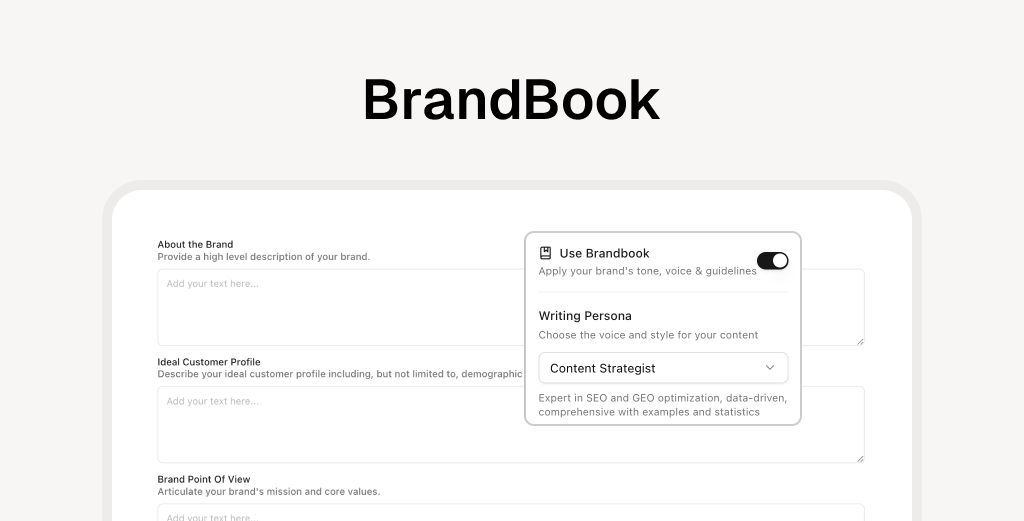
ClayHog includes a brandbook feature that integrates directly with content creation:
- AI-generated brand guidelines based on your existing content and brand information, giving you a starting point
- Custom writing instructions that feed into the content creator for every piece of content
- Persona support for different content types and audiences
- Brand voice integration that ensures generated content matches your tone and terminology
- Logo management for consistent visual identity across exported content
The brandbook connects to ClayHog’s content creator, so every article generated uses your brand guidelines as context. This means you don’t have to manually check every piece for brand consistency.
Getting Started
If You Don’t Have a Brandbook Yet
- Start with your brand basics: name, description, tagline
- Write down 5 terms you always use and 5 terms you avoid
- Define your tone in 3 adjectives (e.g., “expert, approachable, direct”)
- Write a sample paragraph describing your product and use it as a reference
- Use ClayHog’s AI-generated brandbook as a starting point and refine from there
If You Already Have a Brandbook
- Review it for GEO-specific terminology and guidelines
- Add a section on content structure standards for AI search
- Include update frequency guidelines
- Import your guidelines into ClayHog’s brandbook feature
- Test it by generating a piece of content and reviewing it against your standards
Frequently Asked Questions
What is a brandbook in the context of GEO?
A brandbook for GEO is a set of guidelines that defines your brand’s voice, tone, key messaging, and content standards specifically for AI-optimized content. It ensures that all content created for AI search visibility maintains a consistent brand identity.
Why does brand consistency matter for AI search?
AI models build an understanding of your brand from multiple content sources. Consistent messaging, terminology, and tone across all your content reinforces a clear brand identity that AI models can accurately represent in their responses. Inconsistency creates mixed signals.
Can ClayHog generate a brandbook automatically?
Yes. ClayHog can generate suggested brand guidelines based on your existing content, website, and brand information. This AI-generated brandbook serves as a starting point that you can refine and customize to match your exact brand standards.
How often should I update my brandbook?
Review your brandbook quarterly or whenever there’s a significant change in your product positioning, messaging, or target audience. The terminology and messaging sections should evolve as your GEO strategy matures and as AI search terminology standardizes.