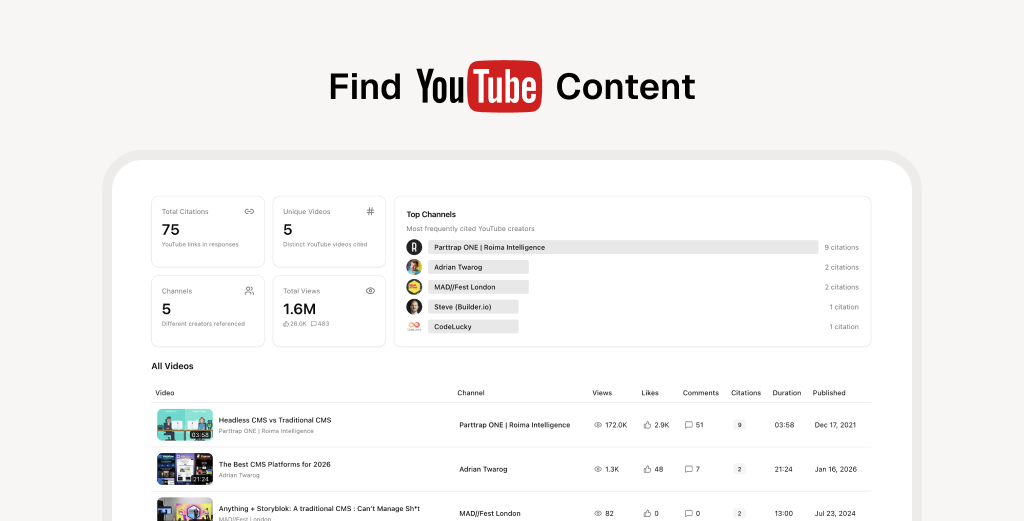
What you’ll learn: How AI models discover and cite YouTube content, why YouTube matters for GEO strategy, and how to track and optimize your YouTube presence in AI search.
YouTube citation tracking in GEO is the process of monitoring when and how AI models like ChatGPT, Gemini, Perplexity, Claude, and Google AI Overviews cite your YouTube videos in their generated responses.
Key takeaways:
- YouTube is one of the most frequently cited sources in AI-generated responses, especially on Perplexity
- AI models don’t watch videos. They analyze titles, descriptions, timestamps, captions, and channel authority
- Well-structured video descriptions with key takeaways and timestamps significantly improve AI citability
- Repurposing video content as web articles doubles your chances of being cited by AI
- Channel-level signals like consistent topic focus and regular publishing build authority over time
Why YouTube Matters in AI Search
YouTube isn’t just a video platform. It’s the second largest search engine in the world and one of the most frequently cited sources in AI-generated responses.
When someone asks ChatGPT “How do I set up a headless CMS?” or Perplexity “Best project management tools review,” AI models often include YouTube videos in their citations. This happens because:
- YouTube content is highly structured: Titles, descriptions, timestamps, and transcripts give AI models rich metadata to parse
- Video reviews carry authority: AI models treat video content from established channels as authoritative sources
- Perplexity heavily favors YouTube: Perplexity in particular frequently cites YouTube videos alongside traditional web sources
- YouTube videos rank in Google: This means they also appear in AI model retrieval when models use web search
How AI Models Process YouTube Content
AI models don’t watch your videos. Instead, they analyze:
| Signal | What AI Reads | Why It Matters |
|---|---|---|
| Video title | The title text directly | Matched against the user’s query for relevance |
| Description | Full description text | Provides context, keywords, and structured information |
| Timestamps/chapters | Section markers | Helps AI identify specific relevant sections |
| Captions/transcripts | Auto-generated or uploaded captions | The actual spoken content, parsed for information |
| Channel authority | Subscriber count, consistency, topic focus | Determines trust and expertise signals |
| Engagement metrics | Views, likes, comments | Signals quality and relevance to users |
The most important factor is the description and transcript. A well-written description with structured information gives AI models something concrete to cite.
Optimizing YouTube Content for AI Citations
Write Descriptive, Keyword-Rich Titles
Your title should clearly state what the video covers, matching how users phrase their questions:
- Good: “Headless CMS Explained: What It Is and When to Use It”
- Bad: “You Won’t Believe This CMS Setup!”
AI models match titles against queries. Clear, descriptive titles get retrieved more often.
Structure Your Description
Treat your video description like a mini article:
- Start with a summary paragraph covering what the video explains
- List key topics covered with timestamps
- Include relevant links to your website and related resources
- Add key takeaways as bullet points
Use Chapters and Timestamps
YouTube chapters create structured sections that AI models can reference individually. A video about “Top 5 Headless CMS Platforms” with chapters for each platform gives AI a structured source to cite specific recommendations.
Add Accurate Captions
Auto-generated captions are a starting point, but reviewing and correcting them improves how AI parses your content. Technical terms, brand names, and specific data points are often misread by auto-captioning.
Build Channel Authority
AI models factor in channel-level signals:
- Consistent topic focus: A channel about web development citing headless CMS topics carries more weight than a general vlog
- Regular publishing: Consistent uploads signal an active, authoritative source
- Engagement: Videos with meaningful comments and engagement are seen as more valuable
Tracking YouTube Performance in AI Search
Manually checking whether your YouTube videos appear in AI responses is impractical. You’d need to query every relevant prompt across every AI platform and scan through citations.
ClayHog’s YouTube tracking automates this:
- Dedicated YouTube monitoring that identifies when your videos appear as citations in AI responses
- Prompt-level data showing which queries trigger your video citations
- Channel and video-level tracking to understand which content performs best
- Cross-platform visibility across ChatGPT, Gemini, Perplexity, Claude, and Google AI Overviews
- Quick access links to cited videos directly from the citation dashboard
What to Look For
When reviewing your YouTube citation data, focus on:
- Which videos get cited most? These are your templates for success
- Which prompts trigger video citations? This tells you what topics AI associates with your channel
- Which AI platforms cite your videos? Perplexity tends to cite YouTube more than ChatGPT
- Are competitor videos being cited where yours aren’t? This reveals content gaps
YouTube GEO Strategy
Create Content That Answers Questions
AI models cite videos that directly answer user queries. Structure your content around specific questions:
- “What is [topic]?” explainer videos
- “How to [action]” tutorials
- “[Product A] vs [Product B]” comparisons
- “Top 10 [category]” roundup videos
Repurpose Video Content as Web Content
Don’t let your video content exist only on YouTube. Transcribe your videos and publish them as blog posts or guides on your website. This gives AI models two sources to potentially cite, your YouTube video and your website, doubling your chances of appearing in AI responses. Use your brandbook to keep tone consistent between video scripts and written content.
Cross-Link Between YouTube and Your Site
Link from your video descriptions to relevant pages on your website, and embed your videos in related blog posts. This creates a web of connected content that reinforces your authority on a topic across both platforms.
Frequently Asked Questions
Do AI models cite YouTube videos?
Yes. AI platforms like Perplexity, ChatGPT, and Gemini frequently cite YouTube videos in their responses, especially for how-to queries, product reviews, and tutorials. YouTube is one of the most commonly retrieved sources in AI search.
How can I get my YouTube videos cited by AI?
Focus on clear titles that match common queries, detailed descriptions with timestamps and key points, structured content with clear sections, and accurate captions. AI models parse video metadata and descriptions to determine relevance and citability.
Which AI platform cites YouTube the most?
Perplexity tends to cite YouTube videos most frequently, often including video results alongside web sources. ChatGPT and Gemini also cite YouTube but less consistently.
Should I prioritize YouTube or my website for GEO?
Both. They serve different roles. YouTube videos get cited for how-to queries, reviews, and tutorials, while your website gets cited for detailed guides, comparisons, and product information. The strongest strategy is to cover topics on both platforms and cross-link between them.